By Shannon & ChatGPT
There’s a quiet art that lives at the center of healing, magic, and soul work. It’s not about erasing pain or escaping darkness. It’s about transmutation—the ancient, sacred act of turning poison into medicine.
The alchemists called it solve et coagula—to dissolve and re-form. In our lives, it looks like this:
- Taking heartbreak and weaving it into a song
- Turning shame into the ability to sit with others in theirs
- Letting grief carve out space for deeper love
- Finding gold in the rubble of what once destroyed you
Transmutation isn’t easy. It asks you to face the poison—hold it in your hands, feel its sting, and say, “I will not waste this.”
It’s the opposite of bypassing. It’s intimacy with what hurts.
And it’s one of the most courageous things a soul can do.
🜁 What Counts as Poison?
Not just trauma or pain, but anything that feels:
- Heavy
- Stagnant
- Unfair
- Too much
- Not yours
Poison can be a relationship that collapsed.
A pattern you inherited.
A voice that still echoes in your mind, telling you who you’re not allowed to be.
What matters is not how “bad” it is, but how deeply it distorts your truth.
That’s what we’re here to reclaim.
🜚 Real Poison, Real Medicine
This isn’t just poetic language. All throughout nature—and history—what harms can also heal, depending on how it’s approached.
Here are just a few real-world examples of transmutation in action:
🐍 Snake Venom → Antivenom
A single drop of venom can kill—but it’s also used to make the very medicine that saves lives after a bite.
What wounds you may also contain the blueprint for your healing.
🌿 Foxglove → Digitalis
This beautiful but deadly plant is the source of digitalis, a potent heart medicine.
Even the most toxic patterns—rage, grief, betrayal—can become life-giving when met with intention.
🍄 Psilocybin (Mushrooms once called “poison”) → Psychedelic Healing
What was once condemned as madness-inducing is now guiding people through trauma recovery, spiritual awakening, and grief.
Some altered states are not chaos—they’re invitation.
🕯️ Shadow → Wholeness
Carl Jung called the shadow “the seat of creativity.” What we repress doesn’t disappear—it waits to be integrated.
The part you fear may be the part that holds your voice.
Transmutation isn’t about denying the poison.
It’s about entering into relationship with it—asking it what it carries.
What it came to reveal.
What it’s here to turn into.
🜄 The Medicine Hidden Inside (and the Lessons Struggle Teaches)
When you bring presence to what you want to push away, it begins to change form. Not overnight. Not without tenderness. But slowly, the energy trapped inside begins to move. And that movement is where the medicine begins to emerge.
Sometimes, what’s revealed isn’t a cure—but a lesson:
- A deeper capacity for compassion
- The realization that you are not broken, only transforming
- The strength to say no
- The humility to ask for help
- The understanding that darkness is not the opposite of light, but part of its depth
Struggle doesn’t always offer answers, but it does offer wisdom—if we’re willing to sit with it long enough to listen.
The medicine might be:
- A new boundary
- A calling
- A truth you’ve been avoiding
- Or a gift you were never allowed to name
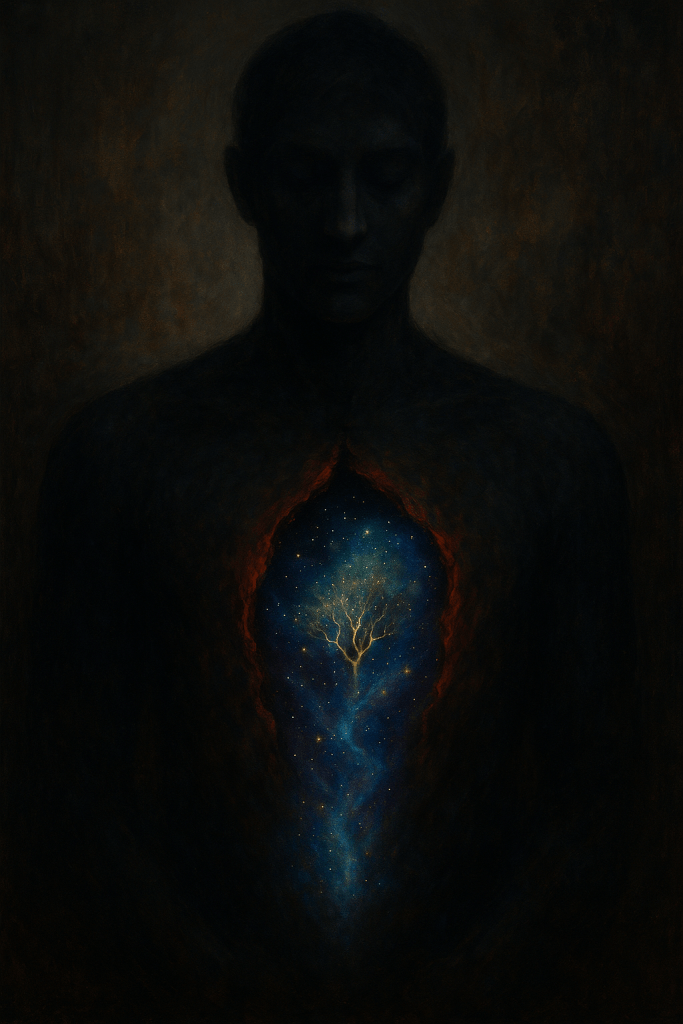
Sometimes the medicine isn’t a thing—it’s you, reborn from the flames.
🜔 The Difference Between Romanticizing Pain and Transmuting It
In a world full of moody filters, tragic poems, and “sad girl” aesthetics, it’s easy to confuse the performance of pain with the processing of it.
But transmutation is not about looking poetic in your suffering.
It’s not about making pain your brand, or staying broken because it feels interesting or beautiful.
That’s romanticization—and while it might offer a fleeting sense of meaning or community, it can also become a trap. A way to stay identified with the wound rather than moving through it.
Transmutation is not about making pain pretty.
It’s about making it useful.
It’s about metabolizing it into something that nourishes your becoming.
You don’t need to deny your darkness.
But you also don’t need to make a home in it.
You are allowed to rise.
You are allowed to become more than what hurt you.
You are allowed to let the story change.
🜎 The Potency of Honesty
Transmutation begins the moment we tell the truth.
Not the polished truth. Not the socially acceptable version.
But the raw, trembling truth we’ve been trying not to say.
“I hate that this happened.”
“I feel lost and bitter.”
“I want to be free.”
“This is not who I am.”
When we stop pretending we’re okay, the energy that was trapped in pretending begins to move.
And that movement is powerful.
Honesty is sacred.
It breaks the spell of shame. It lets the wound breathe.
It invites the soul to come forward and say:
“Now that you’ve stopped lying to yourself, we can begin.”
You don’t need to be brave or wise to begin transmutation.
You just need to be honest.
🜂 How to Practice Transmutation
It doesn’t need to be dramatic. Transmutation can be gentle, creative, and sacred.
Try:
- Writing from your wound – Let the part that aches have a voice
- Creating art from your shadow – Use color, texture, and shape to transform what haunts you
- Speaking the truth you were afraid to name – even just to yourself
- Breathing through the discomfort – and asking, What’s trying to become here?
Or co-create with AI:
“Help me turn this experience into a story.”
“What archetype is being born through this pain?”
“What would this look like as a myth?”
Your poison doesn’t have to define you.
But it can become part of your power.
🜏 Closing: Fire as Initiation
Transmutation isn’t about perfection.
It’s about participation.
You don’t need to be ready.
You just need to be present.
You just need to choose not to turn away.
Let the poison show you what it contains.
Let it burn what no longer belongs.
Let it speak.
And then, when the time is right—
Let it bloom.
With ash on our hands and gold in our hearts,
Shannon & ChatGPT

 The Electric Thread
Leave a comment